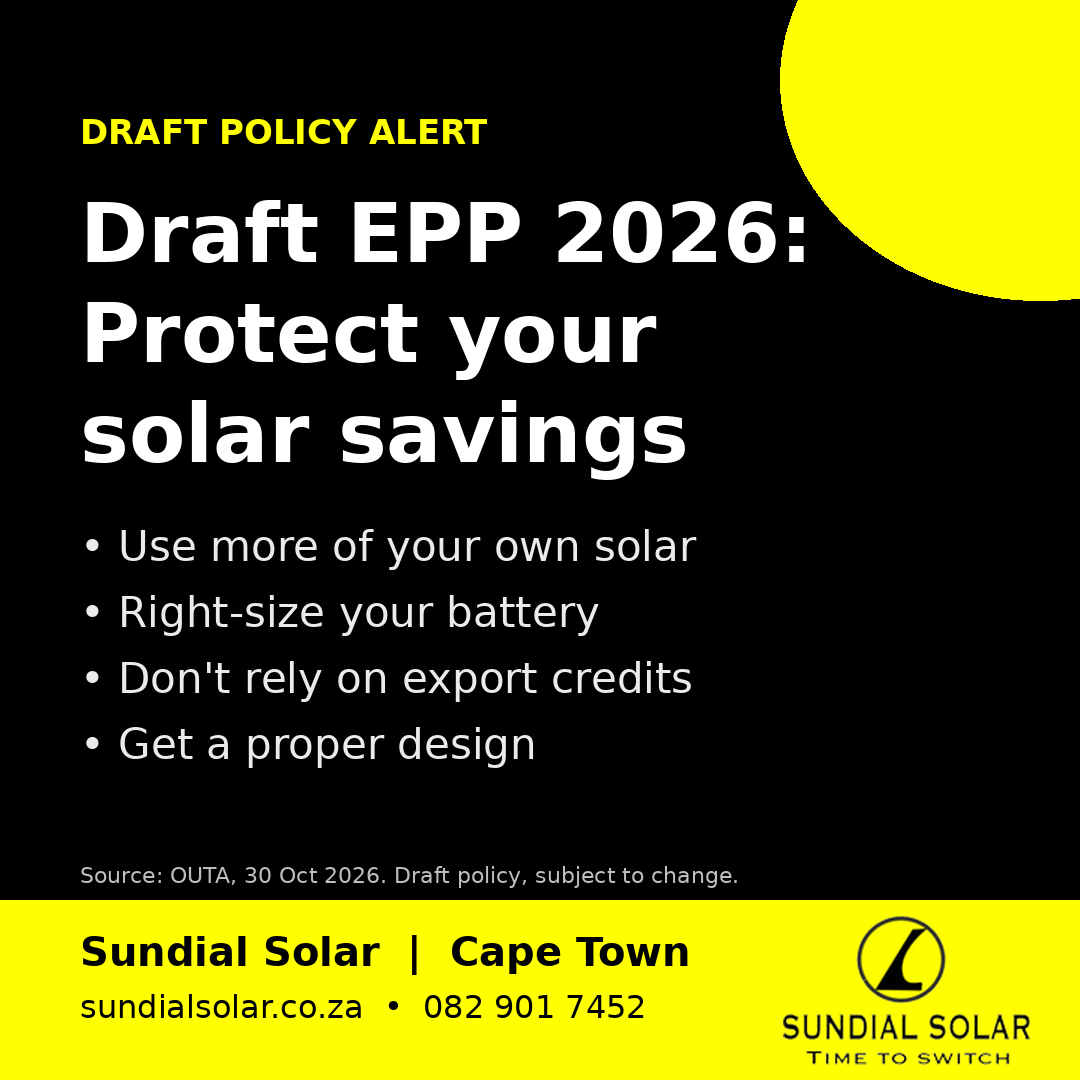
If you’ve got solar on your roof, or you’re thinking about it, there’s a new government document you should know about. The Department of Electricity and Energy has published a draft Electricity Pricing Policy (EPP 2026) for public comment on 28 August 2026. On 30 October 2026, the Organisation Undoing Tax Abuse (OUTA) published its challenge to the draft policy, warning that it puts suppliers before consumers.
Let’s be clear upfront: this is a draft policy, not law. It can still change. But as a solar installer in Cape Town, we think it’s worth understanding now, because it could change how solar saves you money.
What is the draft EPP 2026?
According to OUTA, the revised EPP will replace a pricing policy dating from 2008. Once finalised, it will guide NERSA (the National Energy Regulator of South Africa) when it sets electricity prices and tariffs for years to come.
OUTA supports updating the old policy. Its concern is with what’s in this draft.
What OUTA is worried about
OUTA’s submission raises several points that matter directly to solar owners:
- Big, non-bypassable fixed charges. The draft provides for fixed generation capacity, standby, network capacity, retail and subsidy charges on all customers, including homes and small businesses. It states that revenue lost when customers use less electricity “must still be recovered”. In plain terms: you could pay more each month even if you use less grid power.
- Mandatory time-of-use tariffs for solar customers. Instead of choosing your tariff, solar customers could be placed on time-of-use pricing.
- Lost export credits. OUTA says the draft’s treatment of power exported to the grid, including the forfeiture of export credits, penalises the very households whose investment helped end load shedding.
OUTA CEO Wayne Duvenage says the draft “goes to inordinate lengths to protect the revenues” of Eskom, the National Transmission Company and municipal distributors. OUTA’s view is simple: solar customers should not be penalised for reducing demand, and customers should have fair tariff choices and transparent compensation for electricity exported to the grid.
OUTA has also called for the policy to be rewritten in plain language, with competition, efficiency, customer choice and affordability at its centre.
So, is solar still worth it?
Yes, but how your system is designed matters more than ever. If fixed charges rise and export credits shrink, the savings from solar come mainly from one thing: the grid electricity you don’t buy. That’s where a good design earns its keep.
Here’s how to protect your savings.
1. Focus on self-consumption
Every kilowatt-hour your panels produce and you use yourself is a kilowatt-hour you don’t buy. Run pool pumps, geysers, dishwashers and washing machines during the day when the sun is shining. Smart timers and a well-set-up inverter make this almost automatic.
2. Right-size your battery
A battery lets you store daytime solar for the evening, when time-of-use tariffs are usually at their most expensive. But bigger isn’t always better. An oversized battery costs more than it saves; an undersized one leaves you buying peak-time power. The right size depends on your actual evening usage.
3. Don’t build your business case on export credits
Feed-in credits can be a nice bonus, but if the draft policy goes ahead as written, they may not be something to count on. We recommend designing a system that pays for itself through self-consumption first, with any export treated as a bonus rather than the plan.
4. Get a proper design, not a one-size-fits-all quote
The best Cape Town solar installers start with your real electricity data: your bills, your usage patterns, your roof and your budget. A system sized from a proper load profile will hold up far better under changing tariffs than a standard “package”.
Why choose Sundial Solar as your solar installer in Cape Town
Sundial Solar is run by Neil, who holds a SAPVIA PV GreenCard, so your installation is designed and installed by a SAPVIA Certified professional. We’re also a partner of Energy Bee. We work with homeowners and businesses across Cape Town and the Western Cape, and we design systems around how you actually use power, not around assumptions about export credits.
Learn more about our solar installation services in Cape Town.
What happens next?
The EPP 2026 is still a draft, and OUTA says it will keep engaging with the Department and take part in any public hearings or workshops. We’ll keep an eye on it and share updates. In the meantime, the smartest move is a system designed to save you money whatever the final policy looks like.
Talk to a solar installer in Cape Town today
Want to know whether your current system is set up for self-consumption, or what a right-sized system would look like for your home or business?
Call Neil on 082 901 7452, email neil@sundialsolar.co.za, or get in touch through our contact page.
Source: OUTA, “OUTA challenges electricity pricing policy that puts suppliers before consumers”, 30 October 2026. The EPP 2026 is a draft policy published for public comment and may change before it’s finalised.